
Mister Exam
Other calculators
- Taylor Series Step by Step
- Fourier series step by step
- Differential equations Step by Step
- Product of series
-
How to use it?
- Sum of series:
-
 3^n/n!
- arctan(1/n^2+n+1)
-
 -2
-2
-
 (2/9)^n
-
Identical expressions
- arctan(one /n^ two +n+ one)
- arc tangent of (1 divide by n squared plus n plus 1)
- arc tangent of (one divide by n to the power of two plus n plus one)
- arctan(1/n2+n+1)
- arctan1/n2+n+1
- arctan(1/n²+n+1)
- arctan(1/n to the power of 2+n+1)
- arctan1/n^2+n+1
- arctan(1 divide by n^2+n+1)
-
Similar expressions
- arctan(1/n^2-n+1)
- arctan(1/n^2+n-1)
Sum of series arctan(1/n^2+n+1)
The solution
You have entered
[src]
  oo
____
\   `
 \        /1         \
  \   atan|-- + n + 1|
  /       | 2        |
 /        \n         /
/___,
n = 0
$$\sum_{n=0}^{\infty} \operatorname{atan}{\left(\left(n + \frac{1}{n^{2}}\right) + 1 \right)}$$
Sum(atan(1/(n^2) + n + 1), (n, 0, oo))
The radius of convergence of the power series
Given number:
$$\operatorname{atan}{\left(\left(n + \frac{1}{n^{2}}\right) + 1 \right)}$$
It is a series of species
$$a_{n} \left(c x - x_{0}\right)^{d n}$$
- power series.
The radius of convergence of a power series can be calculated by the formula:
$$R^{d} = \frac{x_{0} + \lim_{n \to \infty} \left|{\frac{a_{n}}{a_{n + 1}}}\right|}{c}$$
In this case
$$a_{n} = \operatorname{atan}{\left(n + 1 + \frac{1}{n^{2}} \right)}$$
and
$$x_{0} = 0$$
,
$$d = 0$$
,
$$c = 1$$
then
$$1 = \lim_{n \to \infty}\left(\frac{\operatorname{atan}{\left(n + 1 + \frac{1}{n^{2}} \right)}}{\operatorname{atan}{\left(n + 2 + \frac{1}{\left(n + 1\right)^{2}} \right)}}\right)$$
Let's take the limit
we find
$$\operatorname{atan}{\left(\left(n + \frac{1}{n^{2}}\right) + 1 \right)}$$
It is a series of species
$$a_{n} \left(c x - x_{0}\right)^{d n}$$
- power series.
The radius of convergence of a power series can be calculated by the formula:
$$R^{d} = \frac{x_{0} + \lim_{n \to \infty} \left|{\frac{a_{n}}{a_{n + 1}}}\right|}{c}$$
In this case
$$a_{n} = \operatorname{atan}{\left(n + 1 + \frac{1}{n^{2}} \right)}$$
and
$$x_{0} = 0$$
,
$$d = 0$$
,
$$c = 1$$
then
$$1 = \lim_{n \to \infty}\left(\frac{\operatorname{atan}{\left(n + 1 + \frac{1}{n^{2}} \right)}}{\operatorname{atan}{\left(n + 2 + \frac{1}{\left(n + 1\right)^{2}} \right)}}\right)$$
Let's take the limit
we find
True
False
The answer
[src]
  oo
____
\   `
 \        /        1 \
  \   atan|1 + n + --|
  /       |         2|
 /        \        n /
/___,
n = 0
$$\sum_{n=0}^{\infty} \operatorname{atan}{\left(n + 1 + \frac{1}{n^{2}} \right)}$$
Sum(atan(1 + n + n^(-2)), (n, 0, oo))
Numerical answer
[src]
Sum(atan(1/(n^2) + n + 1), (n, 0, oo))
Sum(atan(1/(n^2) + n + 1), (n, 0, oo))
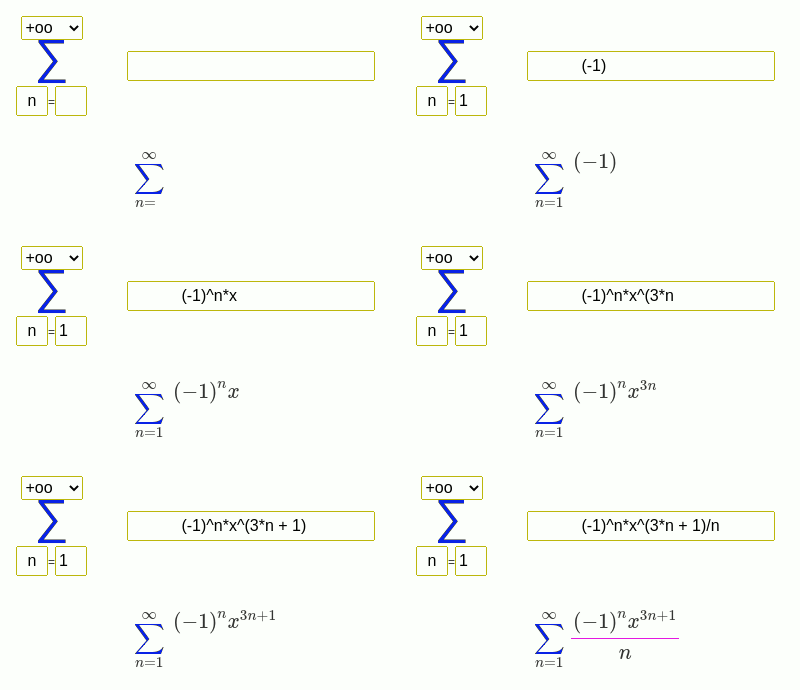
Examples of finding the sum of a series
- The Sum of the Power Series
x^n/n
(x-1)^n
- Factorial
1/2^(n!)
n^2/n!
x^n/n!
k!/(n!*(n+k)!)
- Flint Hills Series
csc(n)^2/n^3
- Basel problem
1/n^2
1/n^4
1/n^6
- Harmonic series
1/n
- Grandi's series
(-1)^n
- Alternating series
(-1)^(n + 1)/n
(n + 2)*(-1)^(n - 1)
(3*n - 1)/(-5)^n
(-1)^(n - 1)*n/(6*n - 5)
- Newton–Mercator series
(-1)^(n + 1)/n*x^n
- Exam the series for convergence
(3*n - 1)/(-5)^n