
Mister Exam
Other calculators
- Derivative of a implicit defined function
- Derivative of Parametric Function
- Partial derivative of the function
- Curve tracing functions Step by Step
- Integral Step by Step
- Differential equations Step by Step
- Limits Step by Step
-
How to use it?
- Derivative of:
-
 Derivative of x^-11
-
 Derivative of x^3+2
-
 Derivative of t^2
-
 Derivative of sin(cosx)
- Integral of d{x}:
- sin(cosx)
-
Identical expressions
- sin(cosx)
- sinus of ( co sinus of e of x)
- sincosx
-
Similar expressions
- arcosin(cos(x/3))
- log(1+2*x)/3-log(x^2-x+1)/6+arcsin(cos(x^(3/7)))/3
- 3arcsin*cosx
Derivative of sin(cosx)
The solution
You have entered
[src]
sin(cos(x))
$$\sin{\left(\cos{\left(x \right)} \right)}$$
d
--(sin(cos(x)))
dx
$$\frac{d}{d x} \sin{\left(\cos{\left(x \right)} \right)}$$
Detail solution
-
Let .
-
The derivative of sine is cosine:
-
Then, apply the chain rule. Multiply by :
-
The derivative of cosine is negative sine:
The result of the chain rule is:
-
The answer is:
The first derivative
[src]
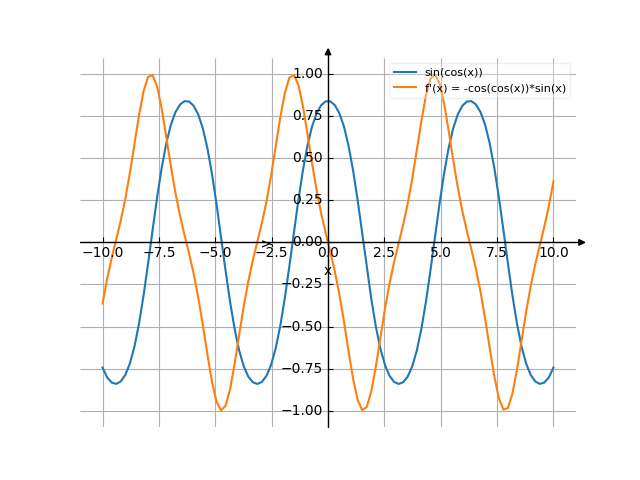
-cos(cos(x))*sin(x)
$$- \sin{\left(x \right)} \cos{\left(\cos{\left(x \right)} \right)}$$
The second derivative
[src]
 /   2                                    \
-\sin (x)*sin(cos(x)) + cos(x)*cos(cos(x))/
$$- (\sin^{2}{\left(x \right)} \sin{\left(\cos{\left(x \right)} \right)} + \cos{\left(x \right)} \cos{\left(\cos{\left(x \right)} \right)})$$
The third derivative
[src]
/   2                                                    \
\sin (x)*cos(cos(x)) - 3*cos(x)*sin(cos(x)) + cos(cos(x))/*sin(x)
$$\left(\sin^{2}{\left(x \right)} \cos{\left(\cos{\left(x \right)} \right)} - 3 \sin{\left(\cos{\left(x \right)} \right)} \cos{\left(x \right)} + \cos{\left(\cos{\left(x \right)} \right)}\right) \sin{\left(x \right)}$$
The graph