
Other calculators
- Improper integral
- Double Integral
- Triple Integral
- Curvilinear integral
- Derivative Step by Step
- Differential equations Step by Step
- Limits Step by Step
-
How to use it?
- Integral of d{x}:
-
 Integral of x^5dx
-
 Integral of y/sqrt(1+y^2)
- Integral of (x)/(x^3-1)
-
 Integral of x/(x^2+4*x+8)
-
Identical expressions
- (x+ two)*e^(-x)
- (x plus 2) multiply by e to the power of ( minus x)
- (x plus two) multiply by e to the power of ( minus x)
- (x+2)*e(-x)
- x+2*e-x
- (x+2)e^(-x)
- (x+2)e(-x)
- x+2e-x
- x+2e^-x
- (x+2)*e^(-x)dx
-
Similar expressions
- (x+2)*e^(x)
- (x-2)*e^(-x)
Integral of (x+2)*e^(-x) dx
The solution
  1
  /
 |
 |           -x
 |  (x + 2)*e   dx
 |
/
0
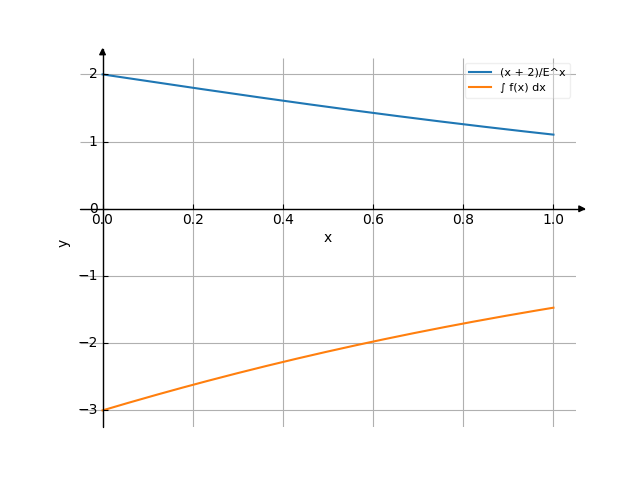
Integral((x + 2)/E^x, (x, 0, 1))
-
There are multiple ways to do this integral.
Method #1
-
Use integration by parts:
Let and let .
Then .
To find :
-
There are multiple ways to do this integral.
Method #1
-
Let .
Then let and substitute :
-
The integral of a constant times a function is the constant times the integral of the function:
-
The integral of the exponential function is itself.
So, the result is:
-
Now substitute back in:
-
Method #2
-
Let .
Then let and substitute :
-
The integral of a constant times a function is the constant times the integral of the function:
-
The integral of a constant is the constant times the variable of integration:
So, the result is:
-
Now substitute back in:
-
-
Now evaluate the sub-integral.
-
-
The integral of a constant times a function is the constant times the integral of the function:
-
Let .
Then let and substitute :
-
The integral of a constant times a function is the constant times the integral of the function:
-
The integral of the exponential function is itself.
So, the result is:
-
Now substitute back in:
-
So, the result is:
-
Method #2
-
Rewrite the integrand:
-
Integrate term-by-term:
-
Let .
Then let and substitute :
-
Use integration by parts:
Let and let .
Then .
To find :
-
The integral of the exponential function is itself.
Now evaluate the sub-integral.
-
-
The integral of the exponential function is itself.
-
Now substitute back in:
-
-
The integral of a constant times a function is the constant times the integral of the function:
-
Let .
Then let and substitute :
-
The integral of a constant times a function is the constant times the integral of the function:
-
The integral of the exponential function is itself.
So, the result is:
-
Now substitute back in:
-
So, the result is:
-
The result is:
-
-
Now simplify:
-
Add the constant of integration:
The answer is:
  /
 |
 |          -x           -x            -x
 | (x + 2)*e   dx = C - e   - (2 + x)*e
 |
/
Use the examples entering the upper and lower limits of integration.