
Mister Exam
Other calculators
- Derivative of a implicit defined function
- Derivative of Parametric Function
- Partial derivative of the function
- Curve tracing functions Step by Step
- Integral Step by Step
- Differential equations Step by Step
- Limits Step by Step
-
How to use it?
- Derivative of:
-
 Derivative of e^(-x^2)
-
 Derivative of x^2/4
-
 Derivative of -e^-x
-
 Derivative of (x)^(1/2)
-
Identical expressions
- e^(two x^2)*ln(sin(x))
- e to the power of (2x squared ) multiply by ln( sinus of (x))
- e to the power of (two x squared ) multiply by ln( sinus of (x))
- e(2x2)*ln(sin(x))
- e2x2*lnsinx
- e^(2x²)*ln(sin(x))
- e to the power of (2x to the power of 2)*ln(sin(x))
- e^(2x^2)ln(sin(x))
- e(2x2)ln(sin(x))
- e2x2lnsinx
- e^2x^2lnsinx
-
Similar expressions
- e^(2x^2)*ln(sinx)
Derivative of e^(2x^2)*ln(sin(x))
The solution
You have entered
[src]
    2
 2*x
e    *log(sin(x))
$$e^{2 x^{2}} \log{\left(\sin{\left(x \right)} \right)}$$
  /    2            \
d | 2*x             |
--\e    *log(sin(x))/
dx
$$\frac{d}{d x} e^{2 x^{2}} \log{\left(\sin{\left(x \right)} \right)}$$
Detail solution
-
Apply the product rule:
; to find :
-
Let .
-
The derivative of is itself.
-
-
Then, apply the chain rule. Multiply by :
-
The derivative of a constant times a function is the constant times the derivative of the function.
-
Apply the power rule: goes to
So, the result is:
-
The result of the chain rule is:
-
; to find :
-
Let .
-
The derivative of is .
-
Then, apply the chain rule. Multiply by :
-
The derivative of sine is cosine:
The result of the chain rule is:
-
The result is:
Now simplify:
The answer is:
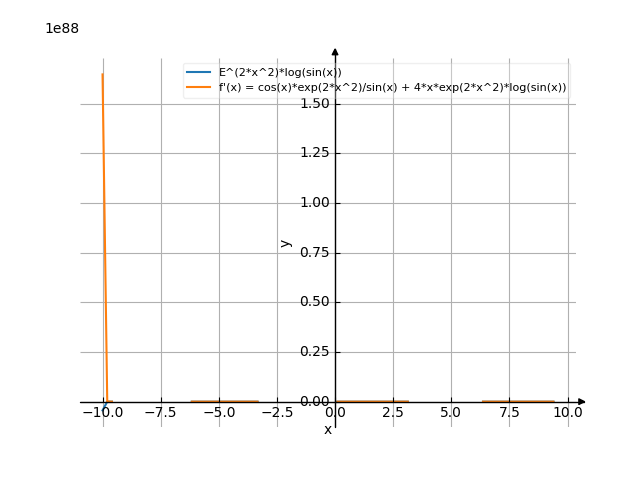
The first derivative
[src]
           2
        2*x            2
cos(x)*e            2*x
------------ + 4*x*e    *log(sin(x))
   sin(x)
$$4 x e^{2 x^{2}} \log{\left(\sin{\left(x \right)} \right)} + \frac{e^{2 x^{2}} \cos{\left(x \right)}}{\sin{\left(x \right)}}$$
The second derivative
[src]
/        2                                           \     2
|     cos (x)     /       2\               8*x*cos(x)|  2*x
|-1 - ------- + 4*\1 + 4*x /*log(sin(x)) + ----------|*e
|        2                                   sin(x)  |
\     sin (x)                                        /
$$\left(4 \cdot \left(4 x^{2} + 1\right) \log{\left(\sin{\left(x \right)} \right)} + \frac{8 x \cos{\left(x \right)}}{\sin{\left(x \right)}} - 1 - \frac{\cos^{2}{\left(x \right)}}{\sin^{2}{\left(x \right)}}\right) e^{2 x^{2}}$$
The third derivative
[src]
  /                      /       2   \                                                          \
  |                      |    cos (x)|                                                          |
  |                      |1 + -------|*cos(x)                                                   |
  |      /       2   \   |       2   |            /       2\                                    |     2
  |      |    cos (x)|   \    sin (x)/          6*\1 + 4*x /*cos(x)       /       2\            |  2*x
2*|- 6*x*|1 + -------| + -------------------- + ------------------- + 8*x*\3 + 4*x /*log(sin(x))|*e
  |      |       2   |          sin(x)                 sin(x)                                   |
  \      \    sin (x)/                                                                          /
$$2 \left(8 x \left(4 x^{2} + 3\right) \log{\left(\sin{\left(x \right)} \right)} - 6 x \left(1 + \frac{\cos^{2}{\left(x \right)}}{\sin^{2}{\left(x \right)}}\right) + \frac{\left(1 + \frac{\cos^{2}{\left(x \right)}}{\sin^{2}{\left(x \right)}}\right) \cos{\left(x \right)}}{\sin{\left(x \right)}} + \frac{6 \cdot \left(4 x^{2} + 1\right) \cos{\left(x \right)}}{\sin{\left(x \right)}}\right) e^{2 x^{2}}$$
The graph