
Mister Exam
Other calculators
- Derivative of a implicit defined function
- Derivative of Parametric Function
- Partial derivative of the function
- Curve tracing functions Step by Step
- Integral Step by Step
- Differential equations Step by Step
- Limits Step by Step
-
How to use it?
- Derivative of:
-
 Derivative of 16/x
-
 Derivative of tan(x/2)-cot(x/2)
-
 Derivative of log(x+3)
-
 Derivative of log(x^2+5*sqrt(x)-3)
-
Identical expressions
- (e^(cosx)+ two)^ two
- (e to the power of ( co sinus of e of x) plus 2) squared
- (e to the power of ( co sinus of e of x) plus two) to the power of two
- (e(cosx)+2)2
- ecosx+22
- (e^(cosx)+2)²
- (e to the power of (cosx)+2) to the power of 2
- e^cosx+2^2
-
Similar expressions
- (e^(cosx)-2)^2
Derivative of (e^(cosx)+2)^2
The solution
You have entered
[src]
             2
/ cos(x)    \
\e       + 2/
$$\left(e^{\cos{\left(x \right)}} + 2\right)^{2}$$
  /             2\
d |/ cos(x)    \ |
--\\e       + 2/ /
dx
$$\frac{d}{d x} \left(e^{\cos{\left(x \right)}} + 2\right)^{2}$$
Detail solution
-
Let .
-
Apply the power rule: goes to
-
Then, apply the chain rule. Multiply by :
-
Differentiate term by term:
-
Let .
-
The derivative of is itself.
-
-
Then, apply the chain rule. Multiply by :
-
The derivative of cosine is negative sine:
The result of the chain rule is:
-
-
The derivative of the constant is zero.
The result is:
-
The result of the chain rule is:
Now simplify:
The answer is:
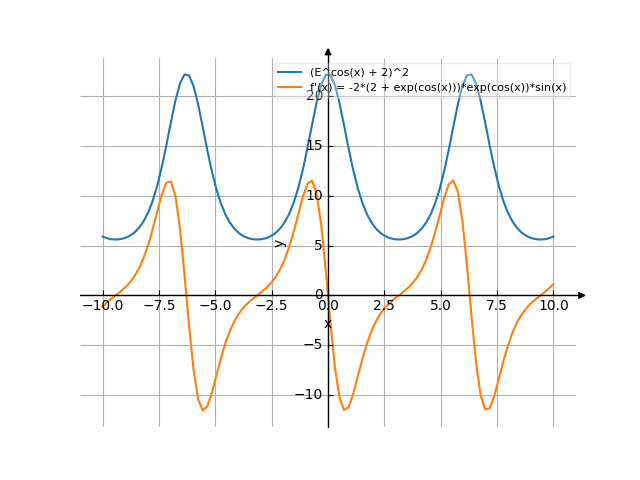
The first derivative
[src]
   / cos(x)    \  cos(x)
-2*\e       + 2/*e      *sin(x)
$$- 2 \left(e^{\cos{\left(x \right)}} + 2\right) e^{\cos{\left(x \right)}} \sin{\left(x \right)}$$
The second derivative
[src]
  /   2    /     cos(x)\      2     cos(x)   /     cos(x)\       \  cos(x)
2*\sin (x)*\2 + e      / + sin (x)*e       - \2 + e      /*cos(x)/*e
$$2 \left(\left(e^{\cos{\left(x \right)}} + 2\right) \sin^{2}{\left(x \right)} + e^{\cos{\left(x \right)}} \sin^{2}{\left(x \right)} - \left(e^{\cos{\left(x \right)}} + 2\right) \cos{\left(x \right)}\right) e^{\cos{\left(x \right)}}$$
The third derivative
[src]
  /       2    /     cos(x)\        2     cos(x)     /     cos(x)\                    cos(x)    cos(x)\  cos(x)
2*\2 - sin (x)*\2 + e      / - 3*sin (x)*e       + 3*\2 + e      /*cos(x) + 3*cos(x)*e       + e      /*e      *sin(x)
$$2 \left(- \left(e^{\cos{\left(x \right)}} + 2\right) \sin^{2}{\left(x \right)} - 3 e^{\cos{\left(x \right)}} \sin^{2}{\left(x \right)} + 3 \left(e^{\cos{\left(x \right)}} + 2\right) \cos{\left(x \right)} + 3 e^{\cos{\left(x \right)}} \cos{\left(x \right)} + e^{\cos{\left(x \right)}} + 2\right) e^{\cos{\left(x \right)}} \sin{\left(x \right)}$$
The graph